Theme: Digital Etiquette and Online Social Skills: Enhancing Professionalism in the Digital Age Organized by: ICT Cell, Government Hrangbana College (GHBC) in collaboration with the Internal Quality Assurance Cell (IQAC), GHBC. Sponsored by: PM-USHA (Pradhan Mantri Uchchatar Shiksha Abhiyan).
Date: 12th – 16th June, 2026 Mode: Hybrid (Offline and Online) Target Audience: Faculty Members, Research Scholars, Administrative Staff, and Higher Education Professionals. Government Hrangbana College organized a 5-Day National Faculty Development Programme on "Digital Etiquette and Online Social Skills: Enhancing Professionalism in the Digital Age" from 12th to 16th June, 2026. The seminar was jointly organized by the college's ICT Cell and Internal Quality Assurance Cell (IQAC), with financial sponsorship from PM-USHA. The program was planned in line with PM-USHA guidelines, which focus on upgrading academic standards and helping colleges adapt to the digital age. By training the staff in online etiquette, data safety, and digital management tools, the college worked towards meeting these national higher education goals. The event followed a hybrid format to suit everyone's schedules. The opening and closing days were conducted offline in the college meeting room, while the sessions over the weekend and mid-week were held as evening webinars on Zoom. The main goal was to give faculty members, research scholars, and administrative staff the practical skills needed to use modern digital spaces professionally.
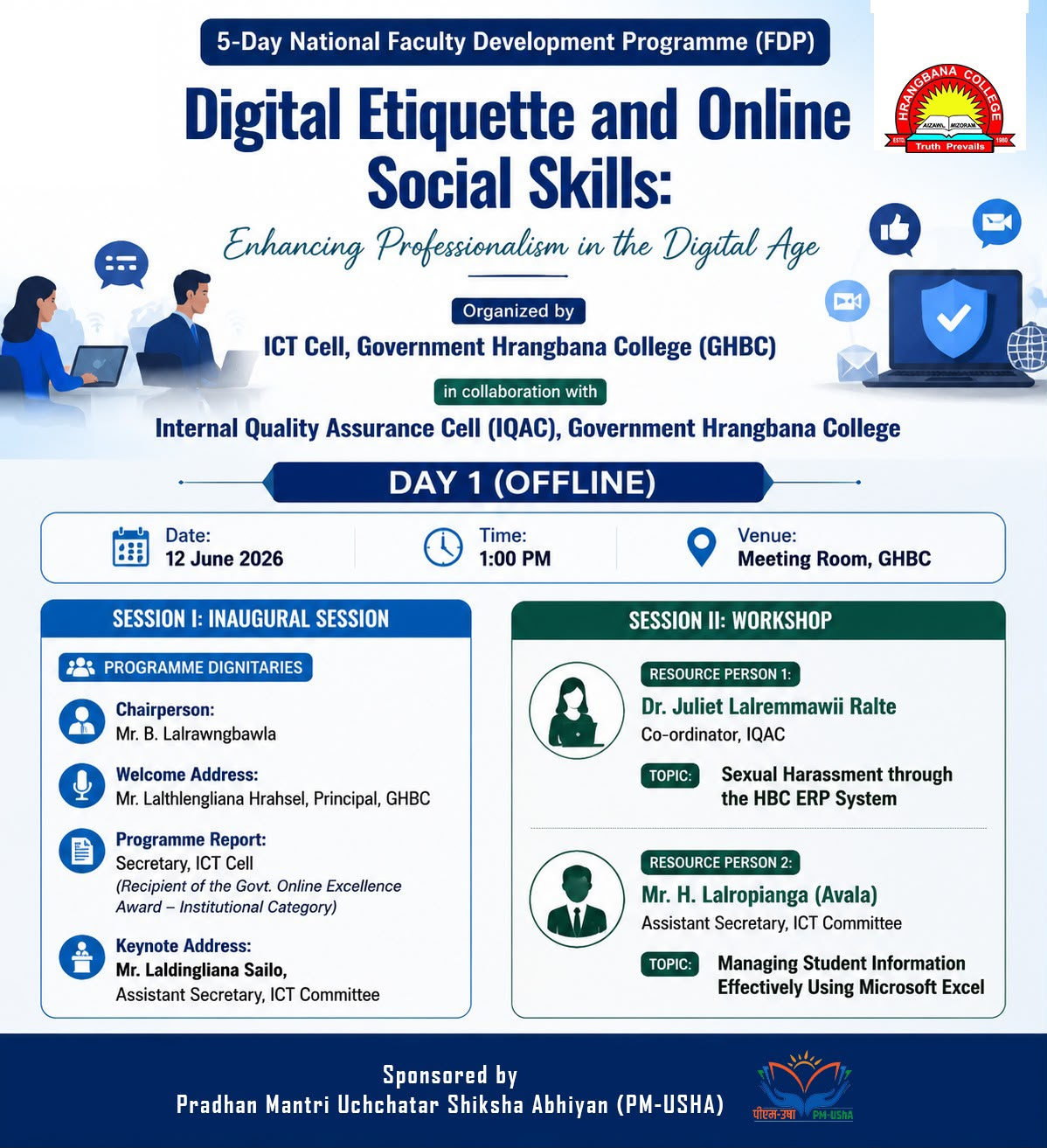
Day 1: 12th June, 2026 (Friday) – On Campus (Offline Mode) The first day was held offline in the college meeting room, starting with a formal session chaired by Mr. B. Lalrawngbawla, Associate Professor, Government Hrangbana College. The Principal, Mr. Lalthlengliana Hrahsel, gave the welcome speech and spoke about why teachers need to maintain digital discipline today, and highlighted the need for teachers to practice strict digital discipline, also emphasizing that teachers need to set a strong professional example online, manage their digital habits responsibly, and protect the institution's reputation by modelling respectful behaviour on technological platforms. He also expressed his gratitude to the organizers for putting together the National Seminar. The Secretary, ICT Cell then presented a report, mentioning that the cell recently won a government award for online excellence. This was followed by a keynote address from Mr. Laldingliana Sailo, Assistant Professor and Assistant Secretary, ICT Committee. In his keynote address, he explains that while technology and software are important in modern digital education, the most critical element is human behaviour online. He defines digital etiquette (or "netiquette") as the rules for respectful and professional communication, while online social skills are the abilities needed to build positive relationships across digital platforms. Together, these skills prevent misunderstandings and create a safe, productive online learning environment. He also notes that while Artificial Intelligence brings massive opportunities to education, it must be used ethically and responsibly. Ultimately, he emphasizes that teachers have a vital responsibility to model respect and professionalism online, guiding their students to become responsible digital citizens. After the opening speeches, the session moved into workshops with two resource persons. The first speaker, Dr. Juliet Lalremmawii Ralte. Coordinator, IQAC, talked about "Sexual Harassment through the HBC ERP System." In her presentation, Dr. Juliet emphasized on the importance of digital safety by sharing a case where a female student faced harassment through the college's internal ERP system. She also highlighted that institutional software must be a secure environment for everyone, and she outlined the necessary steps to address, report, and handle these digital offenses. Ultimately, she urged the institution to protect its community by ensuring that technological platforms are not misused and that students know how to seek immediate help if they experience online harassment. The second speaker, Mr. H. Lalropianga, Secretary, ICT Committee, then gave a presentation on "Managing Student Information Effectively Using Microsoft Excel." The Secretary of the ICT Committee, addresses the recurring communication challenges institutions face—such as repeatedly sharing WhatsApp links, losing track of student statuses, and saving phone numbers without clear context—which ultimately lead to inefficient mentoring. To solve this, he proposes a simple, practical system that integrates Microsoft Excel, Google Contacts, and WhatsApp, requiring minimal technical expertise and only about 10 minutes of setup. By organizing student data purposefully, this three-tool approach delivers immediate institutional benefits: it improves group management, ensures better student identification, and enhances ongoing monitoring. Ultimately, Mr. Lalropianga concludes that this system goes beyond administrative tidiness; it strengthens mentoring, saves time, enables early intervention, and directly supports long-term student success and academic retention.
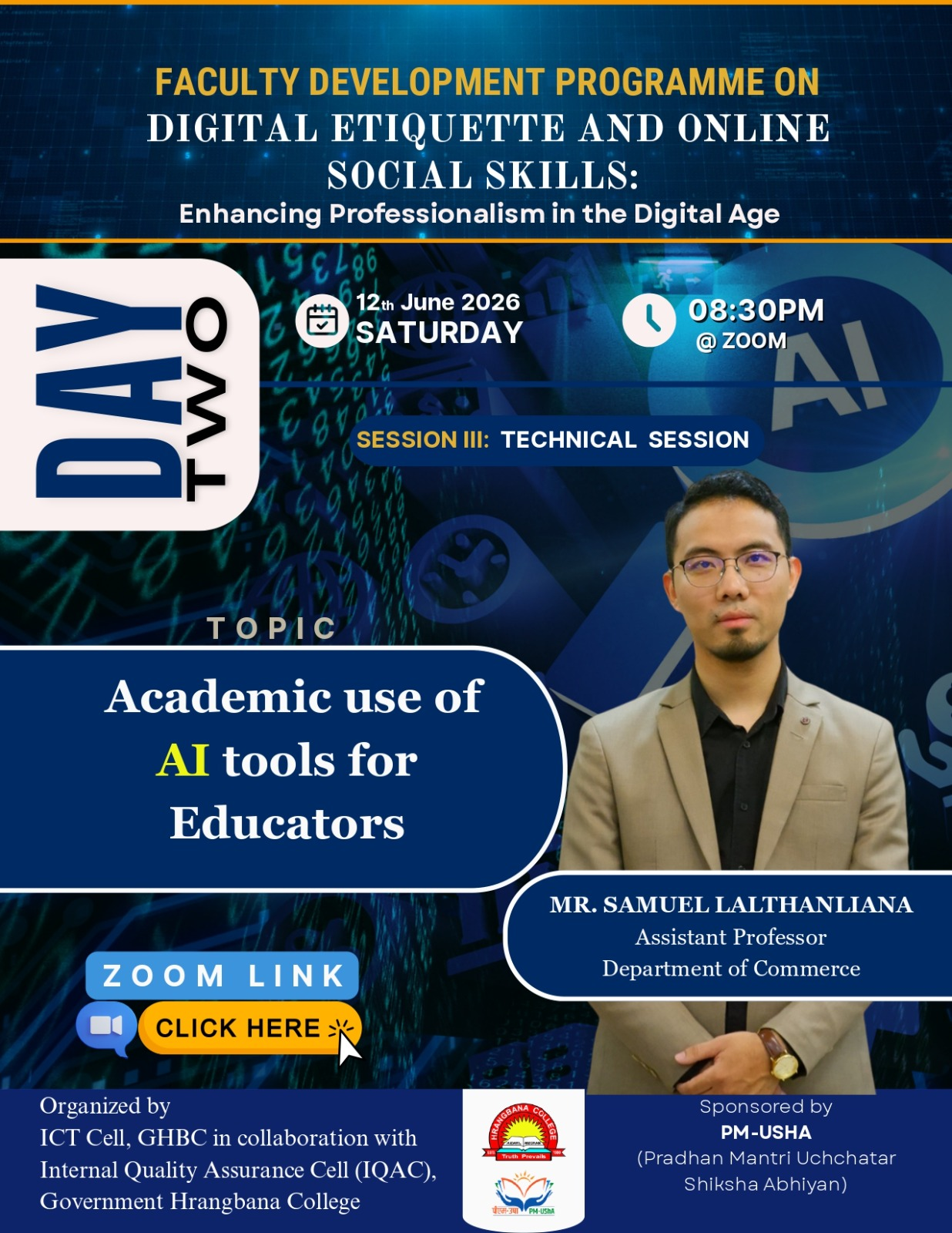
Day 2: 13th June, 2026 (Saturday) – Online via Zoom The second day shifted online for a special evening session. The resource person for this day was Mr. Samuel Lalthanliana, Assistant Professor, GHBC. He presented on the topic "Academic use of AI tools for educators." This presentation shows teachers how to use AI to make their work easier. He explains that AI can help teachers build quick lesson plans, write quiz questions, and do research. To get the best answers from AI, teachers should give it a clear Role, Context, and Task instead of asking vague questions. Lastly, it reminds teachers to always double-check AI answers for mistakes because AI is meant to help teachers, not replace them.
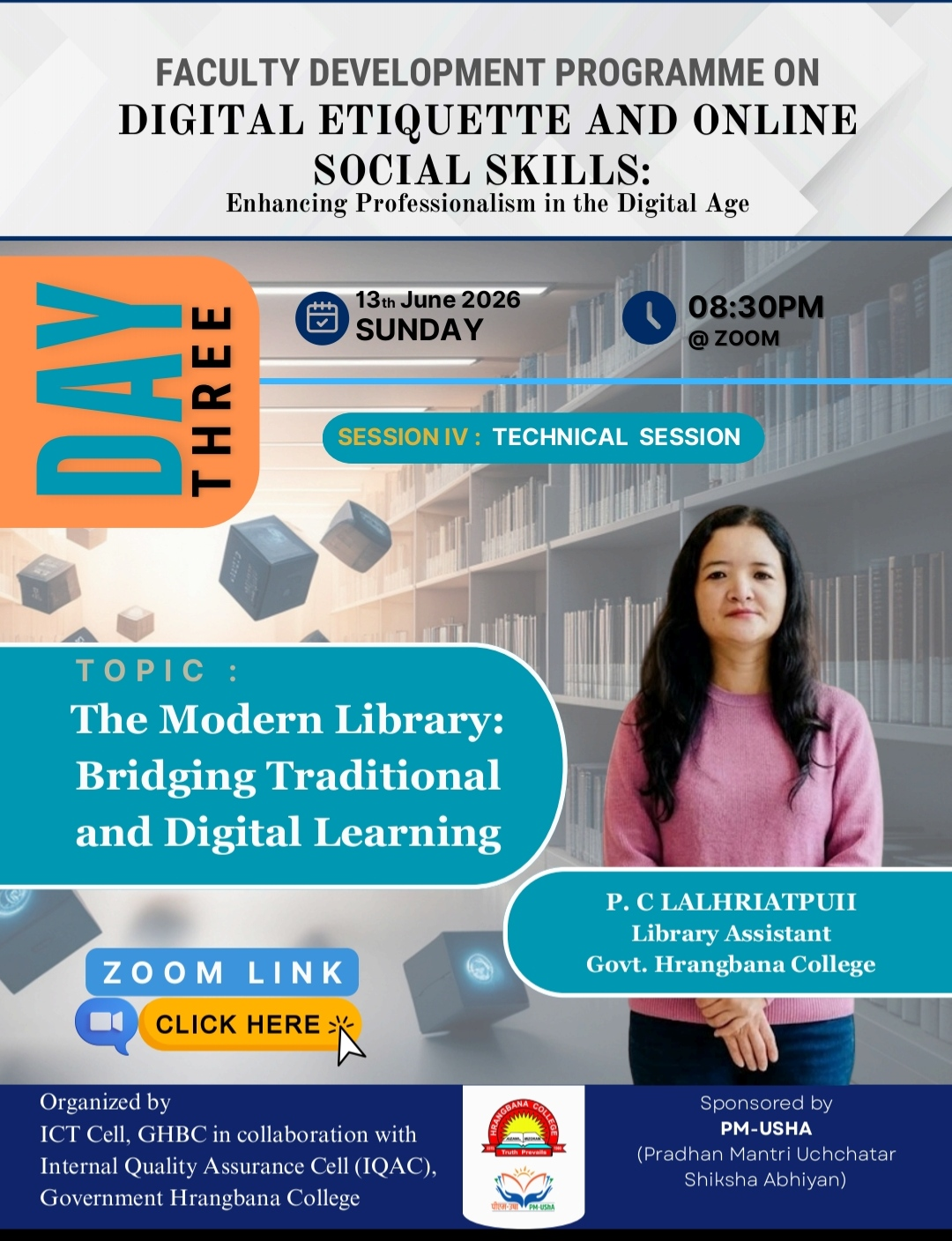
Day 3: 14th June, 2026 (Sunday) – Online via Zoom The third day continued online with an evening webinar focused on the evolution of college resource centers. The resource person was Ms. P.C. Lalhriatpuii (Library Assistant, GHBC), who spoke on the topic "The Modern Library: Bridging Traditional and Digital Learning." Ms. P.C Lalhriatpuii shares how the College Library has grown from a single room in 1980 into an advanced facility with over 22,200 books and modern digital tools. She explains that a modern library does not replace traditional paper books; instead, it creates a bridge by combining physical reading with digital resources like free e-books, online databases, and Wi-Fi. According to the presentation, reading physical books builds deep knowledge and strong language skills, while the digital section provides speed and easy access from anywhere. Ultimately, she encourages students to use both worlds together, ask the library staff for help, and always sign the register to help the college earn a better official grade.
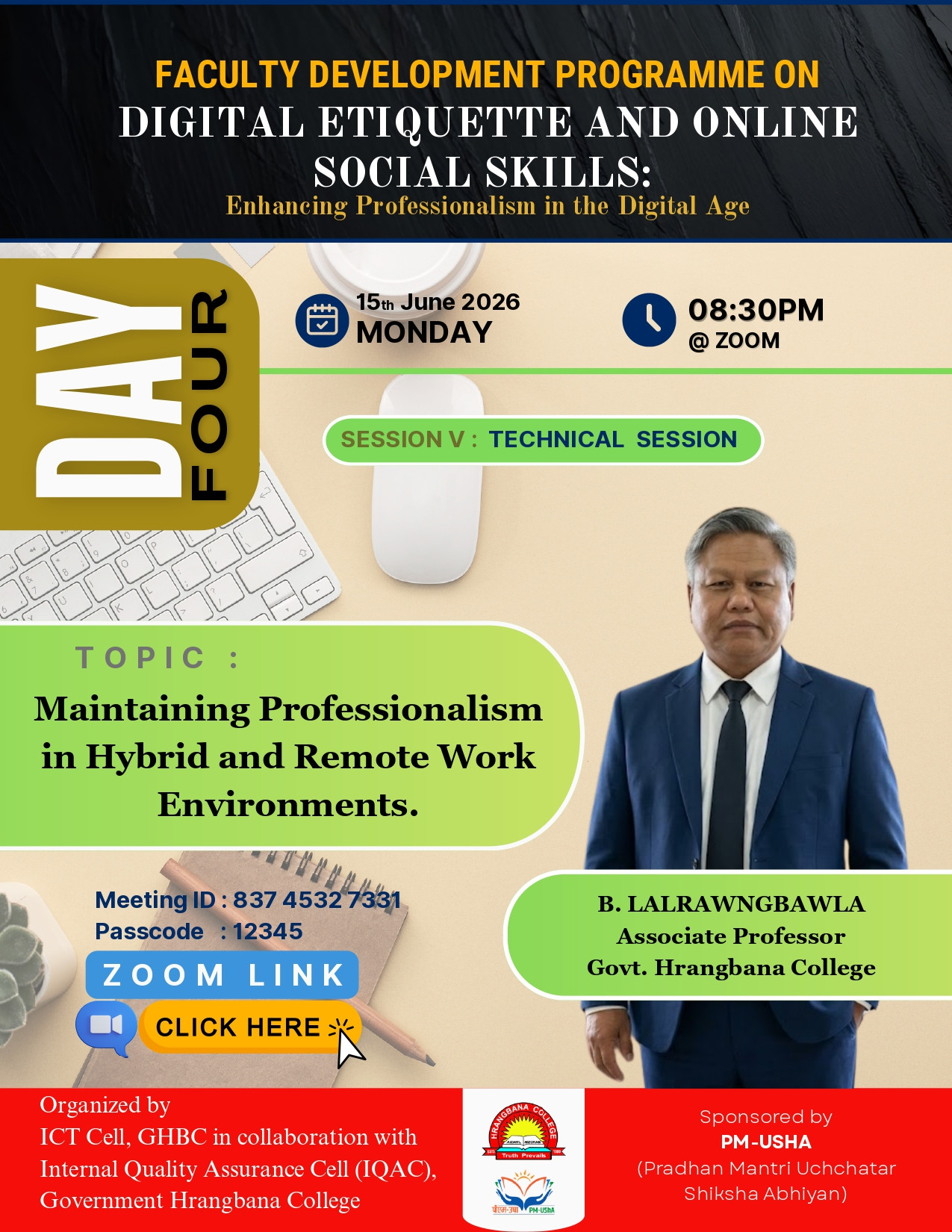
Day 4: 15th June, 2026 (Monday) – Online via Zoom The fourth day featured another online evening lecture. The resource person was Mr. Lalrawngbawla, Associate Professor, GHBC, who spoke on the topic "Maintaining Professionalism in Hybrid and Remote Work Environments." In his presentation, Mr. B. Lalrawngbawla outlines the evolution, immediate necessity, and professional expectations of hybrid and remote work models. In his presentation, Mr. Lalrawngbawla explains that while the COVID-19 pandemic and advancements in digital infrastructure initially launched remote work, businesses eventually transitioned to hybrid schedules—such as the 4-1 or 3-2 models—to combat isolation and protect company culture. Locally, he highlights a distinct and recent catalyst for this shift in Mizoram, noting that due to critical petroleum and energy shortages in India caused by geopolitical tensions in the Gulf region, the Government of Mizoram mandated hybrid work models on May 19, 2026, under directives from the Central government. He points out that despite the advantages of these modern work setups, trust issues between employers and employees remain a significant hurdle. To fix this and keep things professional, he says there are four main things everyone needs to do: keep messages short and polite, treat video calls with the same respect as a real boardroom meeting, respect co-workers’ personal time, and make sure to separate home life from working hours
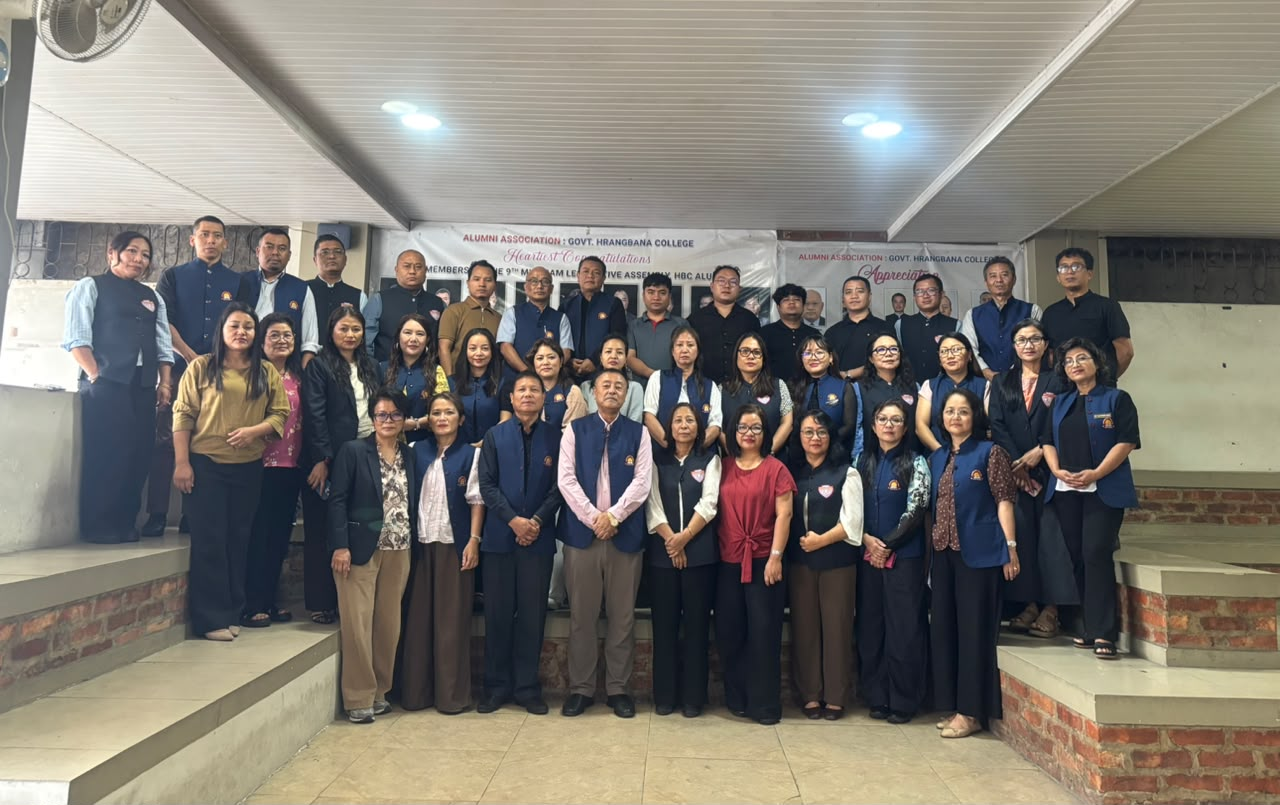
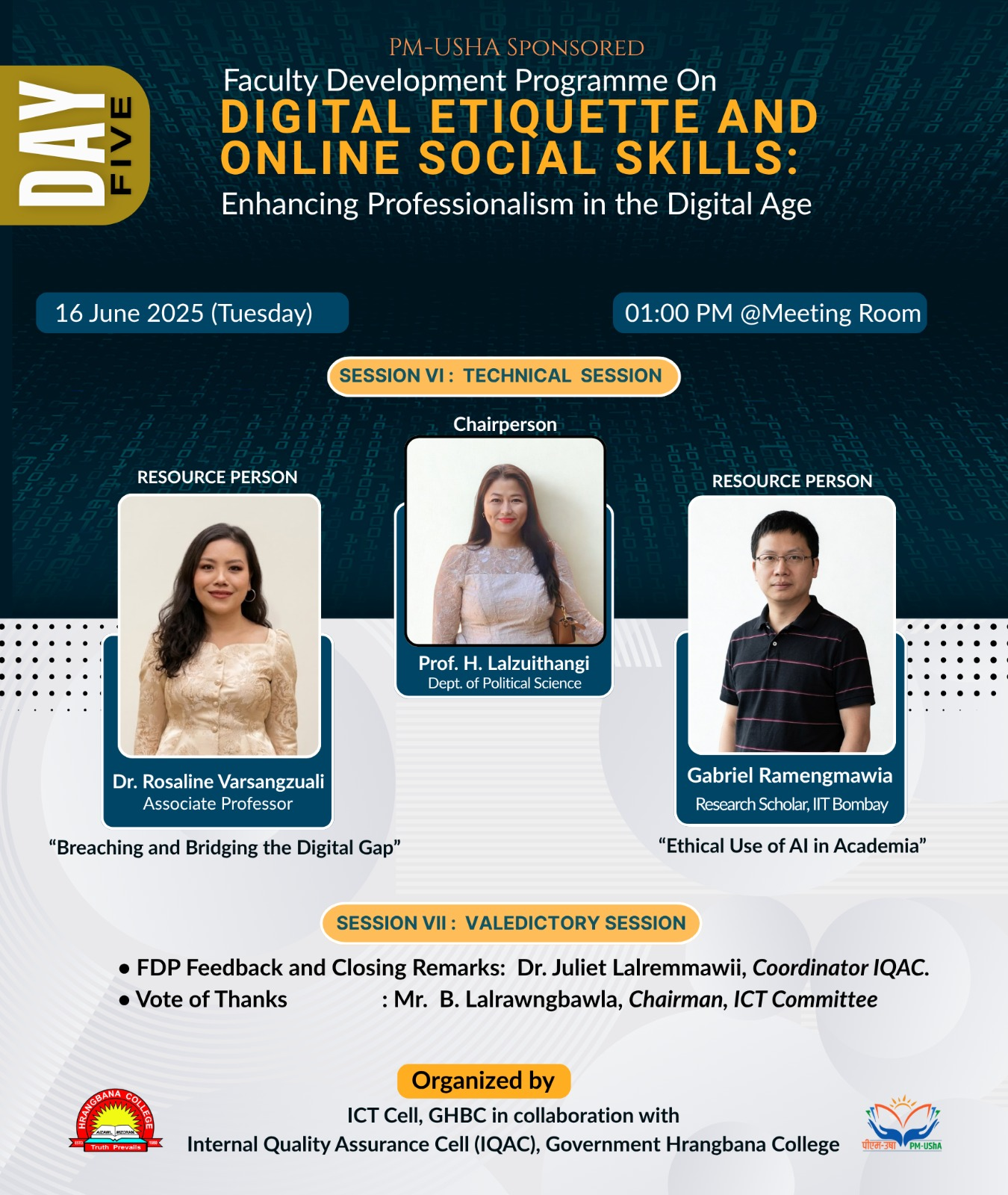
Day 5: 16th June, 2026 (Tuesday) – On Campus (Offline Mode) The final day was conducted offline in the College Meeting Room under the chairmanship of Prof. H. Lalzuithangi. The morning workshops included two resource persons. The first speaker, Dr. Rosaline Varsangzuali, Associate Professor, presented on the topic "Connected or Controlled: Understanding Social Media’s Grip on Us." In her presentation she explores how social media affects our daily lives, questioning whether these platforms truly keep us connected to others or if they secretly control our time, thoughts, and habits. She looks at the powerful grip that social media has on our attention and emphasizes the importance of understanding this balance so we can use technology mindfully rather than letting it control us. The second speaker, Mr. Gabriel Ramengmawia (from IIT Bombay), presented on the topic "Ethical use of AI in academia." In his presentation, Mr. Gabriel Ramengmawia explains that while AI is a powerful tool, it brings serious risks regarding authorship, misconduct, and confidentiality. He emphasizes that AI can never be named as an author or inventor because it lacks legal identity and accountability, meaning any use of AI must be openly disclosed. Furthermore, using AI tools irresponsibly to generate papers without checking for plagiarism, or fabricating fake datasets, constitutes academic misconduct. He also highlights that because AI tools save everything you type into them, sharing private research details creates huge privacy risks. To fix this, organizations like the NIH ban them in peer reviews, making it necessary for universities to start using their own secure, privately run AI systems. Valedictory Session The entire 5-day training concluded with a final valedictory session. Dr. Juliet Lalremmawii, the IQAC Coordinator, shared the closing remarks and presented the feedback report. She proudly mentioned that 95% of the participants responded positively on the official feedback forms. She noted that it was a highly successful programme, maintaining a strong attendance of 45 to 56 participants in every single session across the five days. Finally, she gave a formal vote of thanks, expressing gratitude to the PM-USHA scheme for funding the event, and to all the resource persons and staff. All participants who completed the training were given official certificates handed out by the vice principal, Mr. Lalchangliana.
Link for Presentation Sessions:
2nd Day: https://www.youtube.com/watch?v=HtW9O0UipE8
3rd Day: https://www.youtube.com/watch?v=_tDudO0gHIA
4th Day: https://www.youtube.com/watch?v=GeFvgQq